
Table of contents
AI-Powered Imaging Enhances Early Detection
Machine learning improves pathology analysis.
Real-Time AI Screening Boosts Diagnostic Accuracy
AI’s Role in Personalized Breast Cancer Treatment
AI-Powered Personalized Breast Cancer Treatment
Predictive Analytics Forecasts Disease Progression
AI Supports Immunotherapy Advancements
AI Innovations Driving Surgical and Post-Treatment Care
AI-Driven Drug Discovery Accelerates Treatment Development
AI Monitors Post-Treatment Recovery
Introduction
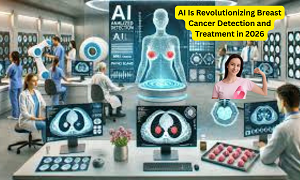
Every year, millions of women undergo breast cancer screening, hoping for early detection that could save their lives. In 2026, artificial intelligence is transforming the fight against cancer by helping doctors detect tumors earlier, personalize treatments, and improve survival rates like never before.
As a result, artificial intelligence (AI) is recognized as a major factor in the complete transformation of how doctors detect, diagnose, and treat breast cancer. AI, in fact, is a combination of machine learning, deep learning, and predictive analytics, which brings new features to breast cancer care in terms of accuracy, speed, and personalization that have never been seen before. This article outlines the revolutionary methods of AI for detecting and treating breast cancer.
AI in Breast Cancer Detection
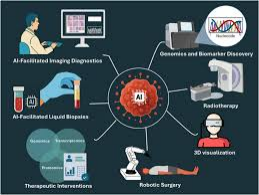
The foundation of better results in breast cancer is early and precise detection. AI contributes to diagnosis from the perspectives of medical imaging and pathological examination, thereby minimizing human errors and enhancing diagnostic speed.
AI-Powered Imaging Enhances Early Detection
Mammography is the primary screening tool for breast cancer; however, it has limitations in detecting faint signs in the case of dense breast tissue. The precision of AI-driven imaging software is attributed to its deep learning feature, which can process thousands of mammograms and find even faint patterns that a human cannot see. With the help of these AI models, radiologists can identify which parts of the breast are masking early-stage tumors, thereby finding the latter with high accuracy.
Advantages:
Cancer is detected at an earlier stage
The cases of false positives and unnecessary biopsies are minimized
The efficiency of a radiologist and his confidence are enhanced
Machine learning improves pathology analysis.
The examination of the tissue samples under the microscope by pathologists had been a traditional, slow, and sometimes subjective process. With the help of AI algorithms that, in fact, analyze the digitized biopsy images, the identification of malignant and benign cells can be done with a very high level of accuracy. Besides, through AI, diagnosis is accelerated since AI recognizes the most subtle morphological changes in cells and tissue architecture, which pathologists have less chance of misclassifying, thereby reducing the possibility of errors.
Benefits:
Pathology workflows are sped up
Accuracy in the differentiation of cancer types is improved
Early treatment initiation is facilitated
Real-Time AI Screening Boosts Diagnostic Accuracy
Current AI capabilities are designed to synergize with screening instruments, thus providing instant feedback during mammograms or ultrasounds. Real-time assessments assisted by these machines enable doctors to make decisions more efficiently; therefore, the follow-up is done quickly for the suspicious findings.
Benefits:
Anomalies are detected immediately
The patient’s best care is ensured during screening
The diagnosis is done without waiting
AI’s Role in Personalized Breast Cancer Treatment
One size never fits all breast cancer patients, and, what is more, tumor cells may behave differently even among the same subgroup of patients with similar diagnoses.
With AI, human precision medicine becomes doable as treatment is planned according to the individual patient’s genetic, clinical, and molecular profiles.
AI-Powered Personalized Breast Cancer Treatment
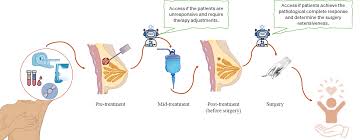
There, AI analyzes the patient-specific genomic data, and based on this, it highlights mutations and biomarkers that impact the patient’s response to therapy. AI’s main role is, in effect, to be the vehicle that takes us there, where the perfect match between patient and therapy is realized; thus, as a result, the treatment effectiveness is improved, and the side effects are minimized. One example could be where AI forecasts that a patient will have a better response when given chemotherapy rather than hormone or targeted therapy.
Benefits:
Personalized therapy plans
Treatment side effects are lessened
Survival rates get better
Predictive Analytics Forecasts Disease Progression
With the patient’s history, tumor biology, and lifestyle taken into account, AI models are in a position to foretell breast cancer progression. Such predictive insights enable clinicians to be more agile in adjusting their treatment strategies, ensuring their intervention occurs before the disease becomes more severe.
Benefits:
Predicts local recurrence or metastasis
Guides the proactive treatment changes
Strengthens the patient’s future health
AI Supports Immunotherapy Advancements
Immunotherapy, to begin with, is a treatment method that is promising for some breast cancers. AI finds the biomarkers and genetic signatures that indicate a patient’s response to immunotherapy. Therefore, it helps doctors to offer the therapy to the right patients who will benefit the most from the treatment.
Benefits:
Immunotherapy selection is optimized
Treatment success rates go up
There is less trial-and-error in picking therapy
AI Innovations Driving Surgical and Post-Treatment Care
Beyond detection and therapy planning, AI is revolutionizing surgical accuracy and post-treatment care.
Robotic Surgery Enhances Precision

AI-supported robotic devices are the surgeons’ guides in the operations of breast-conserving surgeries and mastectomies. What is more, these tools lead to the highest effectiveness of cancer cell removal, contribute to the lowest tissue damage of the healthy part, and result in the smallest number of problems later on. After the surgery, these patients will have a quicker recovery time and have better results.
Benefits:
The surgery is done with more precision
Procedures are less invasive
Recovery is quicker
AI-Driven Drug Discovery Accelerates Treatment Development
The process of coming up with new cancer drugs is very slow and costly most of the time. The acceleration of this process is the primary role of AI, which involves the analysis of molecular structures, the prediction of drug effectiveness, and the identification of the side-effect-causing agents long before clinical trials. What is more, this innovation allows the new therapies to be at the disposal of the patients much earlier; it also improves the overall success rate of drug development.
Benefits:
Effective drugs are discovered faster
The cost of clinical trials is reduced
Novel treatments are introduced to patients sooner
AI Monitors Post-Treatment Recovery
AI wearable tools are there for recording the health of the patients post-treatment, which includes monitoring vital signs, hormone levels, and other indicators of recurrence. Such intelligent systems are there to notify the medical professionals of the first warning signs, thus allowing them to intervene on time and provide continuous support to cancer survivors.
Benefits:
Recovery is constantly monitored
Recurrence is detected early
Breast cancer care is being completely redefined by AI across the entire spectrum of management that essentially comprises detection, diagnosis, treatment, and recovery.
AI integrates advanced imaging, machine learning, predictive analytics, and robotics in a way that provides the following:
A diagnosis that is faster and more accurate
Treatment plans that are tailored for every single patient
Side effects are reduced, and recovery is improved
The development of new therapies is accelerated
There is continuous monitoring for recurrence
FAQs
Can AI detect breast cancer early?
Yes. AI-powered imaging tools can identify tumors earlier than traditional screening methods in many cases.
Is AI replacing doctors in cancer treatment?
No. AI supports doctors by improving diagnosis and treatment planning.
How accurate is AI in breast cancer detection?
Some AI systems now match or exceed radiologist-level accuracy in certain imaging tasks.
Can AI predict breast cancer recurrence?
Yes. Predictive AI models analyze patient data to estimate recurrence risks.
Conclusion
AI breast cancer detection is transforming modern healthcare by enabling faster diagnosis, personalized treatment, and improved patient survival. As machine learning and medical imaging continue to evolve, AI may become one of the most powerful tools in the global fight against breast cancer.


Leave a Reply