
Table of Contents
Why CAR-T Therapy Is Generating Excitement
Other Autoimmune Diseases Being Studied
Risks and Challenges of CAR-T Therapy
A Shift Toward Precision Medicine
Hope for Patients Living With Chronic Disease
Introduction
For millions of autoimmune disease sufferers, living is rather difficult. Autoimmune diseases, like lupus, rheumatoid arthritis, multiple sclerosis, and systemic sclerosis, kind of happen when the immune system gets a little mixed up and then starts attacking the body’s own cells, instead of doing its proper job. The immune system sort of misreads what’s going on, like it can’t tell the difference, so it goes on the offensive. With these conditions, you can get long-term pains and general unpleasantness, ongoing inflammation that just won’t let up, a feeling of being completely drained, possible organ damage, and even episodes that turn serious fast and can become life-threatening. Usually, this unfolds over the course of years.
For years, a lot of treatments for autoimmune conditions have only focused on symptom relief, and honestly, much less attention has been paid to fixing the underlying cause of what’s actually driving the trouble, the root cause, not just the aftereffects.
Immunosuppressants, steroids, or biological medications are recommended for patients to calm a hyperimmune system. Although these drugs help to alleviate symptoms, many people still experience recurring symptoms, fresh adverse effects of medicine, and a lower quality of life.
A groundbreaking medical advancement is thankfully improving conditions. Originally intended as a cancer therapy, CAR-T cell treatment is now being studied by certain researchers to see if it may “reset” the immune system in autoimmune diseases.
The clinical studies being conducted show great promise for this therapy that might even free patients from drugs for a long time.
Even though it is a few years away until it becomes a regular treatment, CAR-T therapy is believed, by many professional clinicians, to be the biggest breakthrough in the treatment of autoimmune diseases for decades.
What Is CAR-T Cell Therapy?
CAR-T stands for “chimeric antigen receptor T-cell therapy.” This is a very customized kind of therapy based on the body’s own defense systems.
It works by modifying the immune cells of patients so that they recognize and kill the bad cells.
Initially, it was a remedy for blood cancers like leukemia and lymphoma. It was found that by genetically modifying T cells, one of the major immune components, they could be helped to efficiently recognize and eliminate the harmful cells.
And this great discovery is now being used for autoimmune diseases as well.
Many autoimmune disorders arise from the anomalous B cells producing the antibodies directed against the body’s own tissues, hence causing issues. CAR-T treatment seeks to eliminate those dangerous B cells so that the immune system will not be damaging the body anymore and will be able to regain normal health.
It is as if the immune system is being rebooted.
How CAR-T Therapy Works
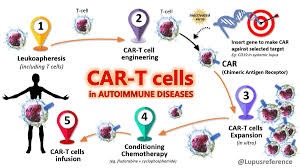
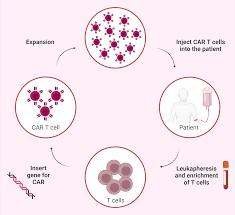
CAR-T cell therapy is very intricate, but it can be simply explained in several key stages.
1. Collecting the Patient’s T Cells
Through a procedure similar to blood donation, T cells are taken from the patient.
2. Genetic Modification
Within the controlled and sterile environment of a laboratory, the T cells undergo genetic engineering that involves introducing a receptor called a chimeric antigen receptor (CAR), which serves as a precise navigation device.
The altered cells are expected to recognize the proteins on the surface of the cancer cells and could, to a great extent, be other cells that have the CD19 protein.
3. Multiplying the Cells
Millions of engineered CAR-T cells are produced in a laboratory environment and prepared for patient treatment.
4. Infusion Back Into the Body
The altered cells are reintroduced to the patient’s circulatory system and start locating and killing the faulty B cells that are leading to autoimmune attacks.
5. Rebuilding the Immune System
Once the detrimental B cells are cleared away, the immune system starts to recover. Scientists are hopeful that after this process, the body will cease to self-destruct.
Why CAR-T Therapy Is Generating Excitement
Many older autoimmune treatments suppress the entire immune system. That can reduce symptoms, but it can also leave patients more exposed to infections and other complications.
CAR-T, on the other hand, addresses the problem by specifically targeting the dysfunctional part of the immune system.
Potential advantages may include the following:
- Long-lasting remission.
- Medication dependence is cut down to the minimum possible.
- The number of autoimmune flare-ups is reduced.
- The quality of life is improved.
- A more targeted immune approach.
There have been patients in clinical trials at the initial stages who have reported great changes since their symptoms have disappeared at times, and they have used immunosuppressive drugs less.
Such results have attracted a good deal of attention in the medical field.
CAR-T Therapy and Lupus
Lupus is the autoimmune disease that generates the most interest concerning CAR-T cell therapy research, among others.
Along with other organs, lupus can really mess with the brain, the heart, the joints, the skin, and the kidneys, in a sort of all-at-once way. A really serious lupus case is kind of challenging to treat with old-school, traditional means.
Lately, in some relatively small clinical trials, favorable outcomes were reported in patients with treatment-resistant lupus.
So lately, my patients attained long-lasting remission following CAR-T therapy and could stop particular drugs under the doctor’s monitoring.
Even if these are kind of preliminary, early-stage studies, researchers are underlining that they cannot yet be treated as proof, not really. Also, they are saying that more rigorous clinical trials will be needed to make sure the long-lasting safety and the actual effectiveness are verified.
Still, the diseases under debate are really hard to heal, and the results so far seem remarkably good.
Other Autoimmune Diseases Being Studied
For many other autoimmune disorders, including the following: Scientists are also studying CAR-T therapy.
- Rheumatoid arthritis
- Multiple sclerosis
- Systemic sclerosis
- Myasthenia gravis
- Inflammatory muscle disorders
Since a lot of autoimmune diseases are centered on B-cell dysfunction, it is expected that one treatment approach may potentially be therapeutic for many different disorders.
This has led to the starting of a whole new area of immune-based therapies that do not just suppress symptoms but act on the level of immune dysfunction.
Risks and Challenges of CAR-T Therapy
CAR-T therapy is not devoid of risks despite all the benefits.
The treatment can cause serious side effects, including:
- Fever and inflammation
- Low blood pressure
- Neurological complications
- Increased infection risk
- Immune reactions
In fact, one of the most frequently encountered complications is CRS (cytokine release syndrome), an immune reaction so severe that patients need close monitoring.
The other problem is, of course, the cost. Another big issue is the cost. CAR-T treatment is still very expensive, and for now, it’s mostly limited to specialized medical centers where the whole process can be managed properly.
On top of that, researchers are still figuring out long- term things that matter a lot:
How long will the remission last?
Do autoimmune symptoms come back later, even if things look good at first?
Can this be expanded safely to bigger populations?
Which patients actually benefit the most
Because these answers aren’t settled yet, most experts lean toward cautious optimism, not hype.
A Shift Toward Precision Medicine
CAR-T therapy is one example of a broader change happening in modern medicine. Rather than getting generalized treatments for broad groups of patients, therapies are increasingly being developed to suit the specific biological mechanisms of the patient.
This is known as precision medicine.
By precisely targeting the pathogenic immune cells, CAR-T therapy has the potential to provide doctors with more effective and less toxic options for treating autoimmune diseases.
Many view this as a major paradigm shift in how inflammatory diseases are treated.
Hope for Patients Living With Chronic Disease
Autoimmune disease can physically and emotionally exhaust those who suffer from it. The truth is that many patients get caught in a vicious cycle of changing medications, managing pain, and dealing with the unknown.
Success in achieving a long-term remission quite naturally guards the promise that future treatments might offer more than temporal symptom control.
Even though CAR-T therapy is still in its early stages, the fact that it has worked in a handful of cases has touched patients and researchers everywhere, like all over the world.
Meanwhile, medical professionals keep making attempts to bolster safety, extend trials, and roll out broader availability.
For people who have been seriously burdened by an autoimmune disease for a long time, even a slim chance at an immune reset is a major milestone.
Final Thoughts
CAR-T therapy for autoimmune diseases is among the most interesting advancements in immunology of the last century.
The closest evidence at the moment supports the reprogramming of the immune system for those patients with a chance to have long-term remission and less dependence on traditional immunosuppressive medications.
Though much remains to be clarified, CAR-T therapy is seen by the researchers as one of the means to transform the future of autoimmune disease management. Ongoing clinical trials may enhance this newly discovered therapy so that it offers a higher level of precision, efficacy, and sustainability for autoimmune diseases than ever before.


Leave a Reply